Grace's Mosaic Moments


Monday, October 22, 2012

THE LAST SURPRISE


Not all surprises are good ones. Lady Christine Ashford, daughter of the Earl of Bainbridge, is enjoying a glorious first season in London when tragedy strikes. Suddenly, she and her two younger sisters are thrust from the glitter of the London ton to the far reaches of Yorkshire, where they must live with relatives until the new earl returns from his diplomatic post in Canada. To compound Christine’s grief, her Yorkshire cousin decides she and her generous dowry are just what he needs, making her situation untenable.

The problem seems to be solved when the girls’ guardian, Harlan Ashford, the new Earl of Bainbridge, returns and makes Christine an offer of marriage. But the shock of her father’s death and the intrusion into their lives of a perfect stranger make it difficult for her to adapt to being a bride.  As Christmas approaches, Christine is faced with two unhappy sisters and a decidedly unhappy husband. She has a decision to make—maintain her strict mourning and intransigent behavior or save her marriage. Is it possible one last surprise, a happy one, can bring Christmas spirit to a house of mourning? And perhaps love as well?


Note: Blair Bancroft is Grace's alter ego.

Ellora's Cave Link:  http://www.jasminejade.com/p-10368-the-last-surprise.aspx

Amazon Link:  http://www.amazon.com/Last-Surprise-Christmas-Surprises-ebook/dp/B009RQV23W/ref=sr_1_1?s=digital-text&ie=UTF8&qid=1350915535&sr=1-1&keywords=The+Last+Surprise

DON'T GO AWAY!   See Suwanee Addendum below:

Shot in the driveway of our Suwanee neighbor's house. And, yes, that's a rattlesnake!   


 I'm inclined to think there's such a thing as getting too far away from civilization.

~ * ~

Coming Soon: Part 2 of "How to Develop Your Characters"


Thanks for stopping by.

Grace
 

Monday, October 15, 2012

HOW TO DEVELOP YOUR CHARACTERS

At a booksigning at Orlando’s Central Library last August, a young lady asked me: “How do you develop your characters?” I gulped and thought fast, because I never took a writing class, read a “how to” book, or even stopped to think about it before. Fortunately, I managed to come up with at least the germ of a reply, but I vowed on the spot to examine the subject more thoroughly and write a blog post about it. So here is Part 1.

                                                    CHARACTERIZATION 

Put quite simply, there is nothing more important than characterization when writing fiction. Even the best Action/Adventure books and the best Erotica feature well-drawn characters. Are there many books that don’t? You betcha! (And I never get beyond the first ten pages.) But most readers demand more than guns/swords/chase scenes/explosions or heaving bosoms and graphically delineated bare body parts. For which writers like me, who really care about our characters, are eternally grateful!

As I have written when critiquing hundreds of contest entries for the Romance Writers of America: readers want to love their hero and heroine. They want to empathize with them, feel their joys, their sorrows, the warmth of that final Happily Ever After. It’s all right for these main characters to have faults. In fact, faults, whether major or minor, usually add color to the story. But readers always need to know that these faults are going to be resolved. Or perhaps realize that the fault is so minor it can be more endearing than annoying.

Secondary Characters are important too. Even though they might not have a Point of View (the story is not being seen through their eyes), they can add an immense amount of color to your book. Villainy, humor, anger, spice, annoyance, etc. The secondary characters can be a sounding board for the Hero’s and Heroine’s thoughts or actions. They can provide shock, condemnation, comic relief. They allow exposition of ideas and plot action through dialogue with the Hero or Heroine. They can also be the Villain or the Bad Guys. As long as you don’t allow them to overshadow the Hero or Heroine (which can happen all too easily), Secondary Characters are vital to a good book.

So how do you make your readers empathize with your characters?
Where do you start?


1.    NAMES.  Your characters can’t come to life until they have names, first and last. When approaching a new book, I spend a lot of time looking through my old baby-name books, searching for first names. I scribble a bunch of possibilities on a yellow legal pad, and then I go on a search for last names. For example, for my Regency books I have a notebook full of typical surnames for the English upper classes. And long lists of less noble English surnames, most of them garnered from the phone book! I also have a book listing all the towns and hamlets in England, an excellent source of last names for that era. If I need foreign first names, an Internet search can be very helpful. Last names? Again, the phone book, adjusting for possible Americanized spellings. (Of course, if you’ve given up phone books, you may have to look elsewhere!) 

    When I have a list of first and last names on my yellow pad, I try pairing them up, seeing which ones will work. Which one best suits my hero . . . which best suits my heroine. Naturally, as I do this, I am forced to think about them, molding vague outlines into more human form. After that, I use a similar method to develop names for the characters in the book’s first scene. As well as any important characters who appear later in the book.

    Is this name search important, worth spending the time? For the Hero, Heroine, and major Secondary Characters, absolutely. The names should suit the people you have in mind. And the process of choosing will help anchor these people in your mind. They go, for example, from “Heir to a duke” and “Engineer’s daughter” to the names you see in the list below. They rise off the paper and become people.


2.    CHARACTER LIST.  After I have created names for my Hero, Heroine, and the characters in the book’s first scene, I type up a  Character List.  I put the character’s name first, then who they are. (If I don’t know the physical description yet, I add it as soon as it becomes clear.)  Example - the first few entries from my newest book, Lady of the Lock (Release Date - c. November 2012):


                                                Character List  -  Lady of the Lock

Bourne Granville Hayden Challenor, Marquess of Montsale  [From Lady Silence]
    Heir to the Duke of Carewe   [added later: brown hair, flint gray eyes, mother - Rosalind]

Amanda Grace Merriwether - a young lady of the upper middle class
    [added later: bronze hair, green eyes, mother - Caroline]

John Merriwether, her father, a canal architect/engineer [added later: blond, blue eyes]    


Lady Eulalia Tynsdale - wealthy & eccentric dowager baroness


Note: at the beginning, before I’ve named everyone, part of the list might read:

Lady Tynsdale’s companion
Nasty mother & daughter in Bath
John’s young engineers
Butler in Bath


As the book progresses, I add each new character to the list, from friends of the h/h to butlers, housekeepers & maids. In Lady of the Lock, the list eventually ran to three pages, plus a scribbled entry for the name of a horse!


3.    FAMILY BACKGROUND. Although you may not use all the people in your main characters’ backgrounds in your book, it is helpful to figure out what their background is. Were they raised with the proverbial silver spoon, or did they struggle in poverty? Were they only children, or was the hero hen-pecked by a bevy of sisters? Did the heroine constantly struggle to keep up with a host of brothers? Is his/her aunt or grandmother kindly or a shrew? Does the father dote on his daughter, or is he, perhaps, a monster?  Has the hero been on his own since an early age? Is he a bastard? Or is his greatest obstacle learning to stand on his own two feet, because he has led too privileged a life? Is there an uncle who wants to do away with the heroine because he will inherit her fortune? Or is the heroine someone who is willing to sacrifice her happiness for her family? Do we have a wounded hero who returns from war to a country where no family waits? Or one who is deluged with so much love and “help” that he has to get away? Do we have a policeman from a long line of law enforcement, or is he the first of his “old money” family to join the force?

    The list of questions you should ask yourself could be endless, but usually only a short Q&A will be enough to get you started. The rest of your characters’ personality traits or outside influences can develop as you go along. Don’t mire yourself down with endless note cards, storyboarding, movie star photos, etc. Get your names down, decide on your main characters’ background and consequent  personalities, and let the rest develop as you begin to know your character better. As you craft dialogue that is “right” for that character. As your character interacts with the other characters in a variety of ways. Each scene should speak to you, as well as to the reader. Telling you who these characters are.


Special Note on Character:  For those who missed Nora Roberts’s description of Tucker Longstreet, posted in “Edit the Blasted Book, Part 5,” please check out my blog for June 18, 2012. It is the most perfect example of delineating a character in a few brief paragraphs that I have ever seen.  Warning:  It is in Omnipotent or Author POV, which seems to be out of favor at the moment. But that doesn't keep this passage from being an outstanding example of characterization. You can always use it as a shining example of how you should develop your hero or heroine in your mind before you begin to write.


For my other blogs on writing topics, see “Index to Writing Blogs,” August 26, 2012.

                                                                          ~ * ~

Next Blog: In Part 2 of “How to Develop Your Characters,” I’ll list more questions you can ask yourself in an effort to create characters with depth, characters readers can empathize with, characters readers can love, hate, laugh with, etc. (From the many notes I wrote myself today, I suspect this topic may run to a Part 3.)

Thanks for stopping by.

Grace, who writes as Blair Bancroft 

Blair's Website
or check out my books on Kindle, Smashwords, Nook, et al

Saturday, October 6, 2012

WAY DOWN UPON THE SWANEE RIVER, Part 2

The Suwanee, which was leveed long enough ago that trees have grown up


To view the Suwanee, you have to climb 8-10 feet up the levee. To fish, about 20 feet down.

Today's blog is a continuation of last week's tale about my trip to the Suwanee in northern Florida. If you haven't read Part 1, you can scroll down and find it below this post.

Cliffhanger: What was a deputy sheriff doing at the family hideaway in the middle of nowhere at 3:15 a.m.?

Would you believe, someone in this back end of nowhere saw the truck driving past at 2:30 a.m. and called the Sheriff's Department because they were afraid we were thieves about to take furniture OUT of the house? We reassured the deputy that we were bringing items IN, not taking things out, and that the home was under new ownership. (I guess with a mother, grandmother and three young children all hovering in the background, the three men didn't look too criminal.) We also told him we were delighted to discover that such a good watch was kept on such an outlying area. Whew! Now we could finally go to bed.

I paid little attention to my room in the middle of the night, except to take great care winding my way through the narrow corridor to my bed. But while huddling in there the next day, editing a manuscript, while our three guys tiled and laid floorboards so diligently there was no place to walk, I made a list of the contents of the room: an ugly utilitarian desk with high top, obviously salvaged from the original furnishings. But it was mostly hidden behind an anonymous 4 x 6 wood panel the men dragged in just before starting the floors. In a corner by the desk: numerous 10-foot strips of white molding, five fish poles (with a good-size fish net on top of the desk extension). Also in front of the desk was a huge cardboard carton (30x30x30?), which was supposed to contain pillows but was later discovered to be full of assorted comforters and blankets. (Note: I'm just getting started!) 

I laid out my water glass and eyeglasses on an unopened, upturned box of an 18-piece set of pots and pans (which the kitchen was not yet ready to receive). My cosmetics bag sat on a pistol target! At the end of my bed were three folding chairs (folded) and five huge cartons of canned vegetables. The closet (doorless) was stuffed with an assortment of unidentifiable oddments. About all that stood out in the jumble was a sewing kit I had put together for my daughter at some time . . . and a liquor bottle. Oh yes, my room was also doorless. I didn't get a door until late Saturday morning - when we talked the guys into taking a break from doing floors. 

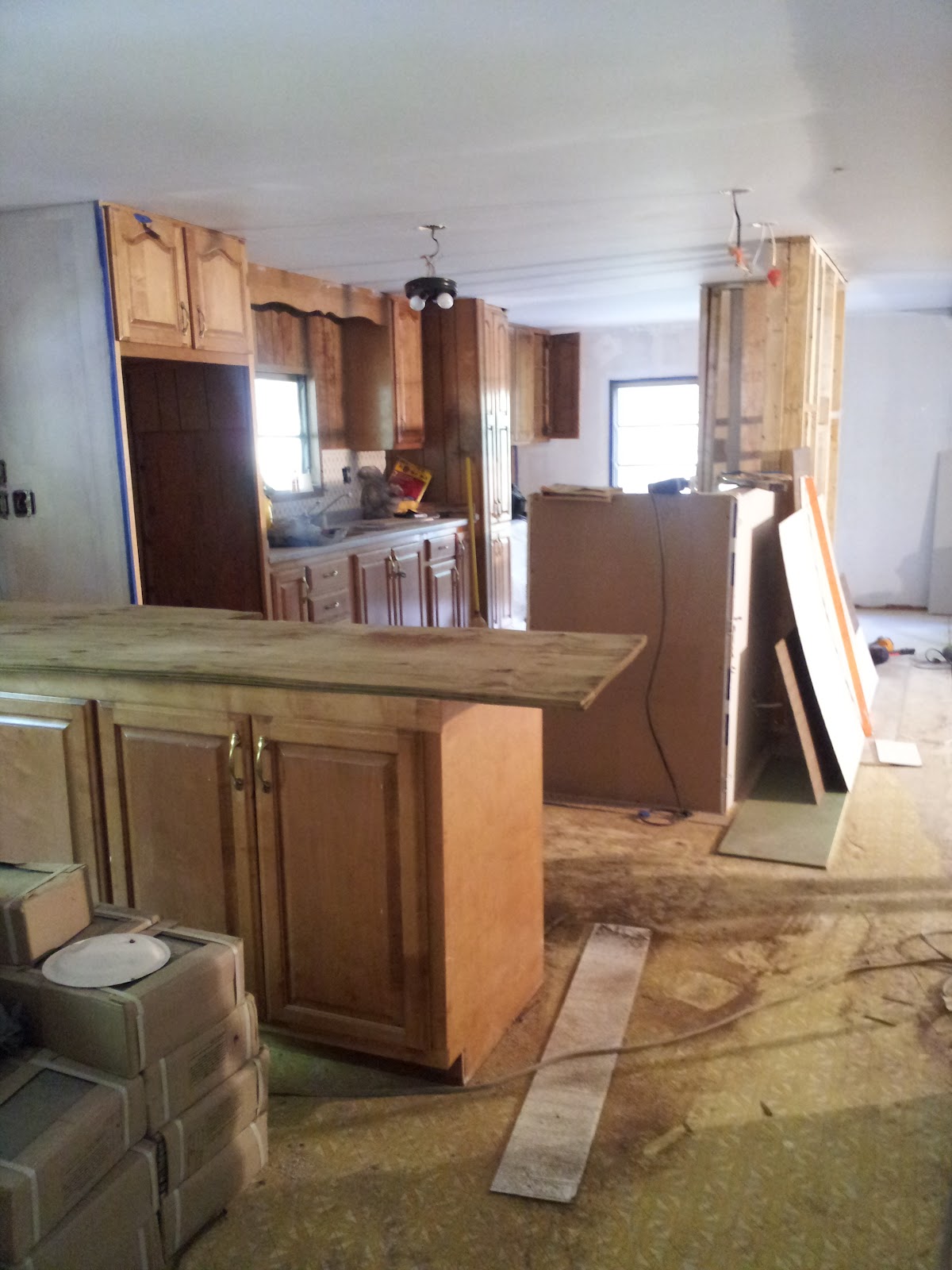
Kitchen under construction
This is the kitchen on Labor Day weekend. Fortunately, by the time I arrived a couple of weeks later the kitchen had acquired a coffee pot, a toaster, and some utensils. (No sugar.) So, thank goodness, we were able to have coffee & pastries for breakfast.

Kitchen area and a bit of the unfloored living room


The reason why underbrush & some trees had to be cleared
I'm told the entire woods was filled with them!


I am happy to say that when we walked down to the river, we did not see a single one of the above. It is, however, exactly like the spider we hit when we were creeping past the truck on the grass verge during our emergency on the Florida Turnpike. No wonder the little girls screamed every time we rolled down the window to talk to the men. They were certain the spider was clinging to the car, just waiting to jump in. We did see some some insects on our walk to the Suwanee—about 3-4" long, wearing a yellow & brown camouflage pattern. We eventually discovered they were praying mantises. Very odd, as the ones I'd seen in Connecticut were c. 6" and lime green. (The difference between lawn mantises and woods mantises?)


Living Room with new floor, new furniture, new sheer curtains & draperies
While the men sawed, glued, grouted tile, and moved large appliances, the five females drove to town (an hour round-trip). I shopped for groceries (including two kinds of sugar!) while my daughter bought the curtains, draperies, & couch cushions seen above, plus a "grout sponge" the men said they absolutely had to have. Also the kitchen towel, oven mitts, knife set, etc., seen below. By Sunday the place was almost looking civilized. My room? Still exposed to the outside world (no curtains), but at least I had a door between me and the hallway!

Kitchen by Sunday afternoon
Beautiful, right? Except that shortly after we returned from town, I heard a scream and came dashing out of my room to find a tableau of people poised outside the open door beneath the sink. It seems the exterminator had been there while we were shopping, and when my daughter opened the cabinet door, there was a mouse stuck to some kind of mouse-trapping sticky paper. The problem - the mouse was still alive and no one would touch it. Among our three brave men, only one was willing. He told the little girls he let the mouse go outside. It is, however, far more likely the mouse is now resting in mouse heaven. 

 However, the house now boasted a full floor, genuine wood dining table and six chairs, plus a just-hung chandelier, so about an hour later we had our first meal in the hideaway. Hamburgers grilled on the screenless screen porch (which also contained mountains of timber and a skill saw). With the addition of chips, salad & dressing from the groceries we bought in town, we dined in what seemed like true splendor after all the chaos.

We even found some time to play. I thought to help the six-year-old play poker but when I advised folding, she returned a resounding "No!" And won. On the family's next visit, however, the nine-year-old beat everyone with a Royal Flush, as can be seen below.


I hope you've enjoyed this all-too-true tale of "Way Down Upon the Suwanee River." When I sang Stephen Foster's song as a child in New England, I never expected to actually see the river. Or spend a couple of nights in a hideaway along its banks.

ADDENDUM to the Suwanee experience. Three weeks later . . .

Shot in the neighbor's driveway - and yes, that's a rattlesnake.
 One can't help but wonder if "getting away from it all" is worth the angst.

Bye-bye, Su-wan-eee . . .

~ * ~ 

 
Thanks for stopping by. If no other unusual adventures crop up, I hope to get back to writing topics in my next blog, most likely a response to a question I was asked at a recent book-signing: "How do you develop your characters?"

Grace

P.S.  If you're so inclined, please check out my website at http://www.blairbancroft.com/  or simply search "Blair Bancroft" on Kindle, Nook, Smashwords, Sony et al.


Sunday, September 30, 2012

WAY DOWN UPON THE SUWANEE RIVER

Or There's Such a Thing as Too Far Away
Or A Visit to Spider, Snake & Rodentville, Not Far south of the Okeefenokee*

When I was growing up, Stephen Foster was a beloved composer of American music. We sang his songs all the time. I knew most of them by heart. But he wrote about a South that no longer exists - and rightly so - and we turned our backs on his music, along with the culture that spawned them. The only time we hear a Stephen Foster song now is just before the running of the Kentucky Derby when the singing of “My Old Kentucky Home” still brings tears to the eye.


*If you don't recognize the word, the Okeefenokee is a very large swamp in southern Georgia.
  
A couple of weeks ago I was strongly reminded of Foster’s “Suwanee River,” which begins: “Way down upon the Suwanee River, far, far away . . .” Because that is where I surely was - after a nightmare trip to get there.


Here’s how it happened.

Our extended family has acquired a hideaway “down upon the Suwanee River.” And, yes, it is definitely “far, far away” from Orlando.  Very far away - 3½ hours if nothing goes wrong. (You’ll notice the italics on “if”!
And, no, I had no hand in picking it out.) Since my daughter and son-in-law run a real estate investment business and do frequent rehabs, they were not put off by a manufactured home that required them to “start from scratch.” At the time I visited, half the new flooring was in, a couple of bedroom rugs, living room furniture, two dining tables + chairs, and an odd assortment of beds. We were bringing with us a truckload of appliances and “fixings,” including range, refrigerator, dishwasher, and TV.

In addition to the renovations already under way, they had been forced to hire a contractor to thin out the trees and brush around the house as the very large spiders in that area spin webs from tree to tree, making it necessary to “broom” one’s way to the river. Not to mention the rattlesnakes. (I think the grandchildren have been traumatized for life.) The camouflage-colored praying mantises, however, are kind of cute. But the house was now supposed to be ready for "camping out" company and I was invited to see it for the first time.

Friday night. We set out late, several hours past the time we were supposed to leave, but we still should have arrived before midnight.  (Fortunately the grandgirls, ages 6-9, are nightowls). My daughter Susie, son-in-law Mike, the girls & I were all in an SUV, playing “chase” car to the truck, which was being driven by Mike’s cousin and a friend. We were connected by walkie-talkies, and the men were thoroughly enjoying doing Smokey and the Bandit jokes as we hit the Florida Turnpike.

My daughter, who was driving, did not like poking along behind the truck. She finally got fed up and passed them. We were about a half mile ahead when the walkie-talkie squawked: “The truck’s on fire. Come back, come back!”

And there we were backing up on the Florida Turnpike! (On the grass, of course.) But backing up, nonetheless, toward a truck that was stopped dead on the grass verge with no lights while three lanes of traffic whizzed by at 70+ mph. When we finally got there, smoke was pouring from the front of the truck. “Turn around,” came the order, “so we can see.” So Susie somehow manages to turn the SUV around without straying into the traffic lanes and we focus the headlights on the truck. (We can now see the billows of smoke even more clearly.) Mike, meanwhile, has jumped out and the men have all disappeared somewhere inside the truck.

New orders: we have to drive to the back of the truck and turn on our blinkers so drivers can see the broken-down truck. This is easier said than done as the truck is so far off the road, all the grass left is at a 40° angle down to the brush below. Very carefully we ease the SUV around the truck on the soft, rain-soaked grass and are making progress when we run into a giant spider in a web that must have been three or four feet across. The little girls’ screeches add to our already jangled nerves.

We finally make it, but the SUV’s rear end is now facing the truck, so once again Susie has to turn around, pointing our headlights at the truck and starting our red emergency blinkers. Mike’s cousin finds a large industrial flashlight in the rear of the truck and stands there swinging it and waving traffic around us. Fortunately, luck was with us, but it was a very bad half hour or so. The problem turned out to be a fire in the electrical system, not in the engine. A fire extinguisher put it out, and Mike managed to fix the problem. The joy when we saw the truck’s lights come back on!

After that, of course, we had to find a place to pull off, eat, and unwind a bit. But there was a lot more Florida Turnpike left, plus I-75, plus back roads that led to dirt roads that led to more dirt roads. We arrived at 2:30 a.m. and after all that, the truck had to be backed down a long, curving, tree-lined driveway so all the appliances could be unloaded in the morning. At 3:15 a.m., when I was just beginning to get settled in my room (more on that in the next installment), I hear one of the little girls running by, calling, “Mommy, Mommy, there’s a stranger at the door!”

Would you believe a Deputy Sheriff? At 3:15 a.m. in the middle of nowhere?

More on “Way down upon the Suwanee River” in my next blog.


~ * ~ 
Addendum to "What Grace Reads":

I failed to list one of my favorites in the "Unclassifiable" category - Lindsay Buroker's marvelous series, The Emperor's Edge. It's action/adventure in a star system far, far away, which is hanging somewhere between the steam age, the agrarian age, and the dawn of modern weapons. (Sci Fi Steampunk with a dash of Magic?) Buroker took an Imperial assassin from an early book and parlayed him into the coolest, coldest, most impossible hero, who is mellowed only a degree or so each book by the humanitarian impulses of his new boss, the female leader of "The Emperor's Edge." The series is strictly for those who like a good story. If you want hot sex, look elsewhere.

Thanks for stopping by.

Coming soon: How to Develop Your Characters


Sunday, September 23, 2012

GRACE'S RUSSIAN CONNECTION


A long time ago, during the Cold War, a group of twelve adventurous Americans traveled 10,000 miles in what was then known as the USSR, the Union of Soviet Socialist Republics. I was one of them. I had prepared for the trip by studying Russian one-on-one with a young woman at Yale. She and her husband had defected from the USSR at a time when one did not ask how they managed it. She was Moscow-born, and that is the Russian I learned. Not one word of English was spoken during my lessons, including the very first, so it was “learn conversational Russian or bust.”

My roommate on the trip had studied Russian too and was making her second trip to the USSR. Also with us was a man who had been a merchant seaman on the Murmansk Run during WWII. (For the youngsters among us - the Murmansk Run was the extremely hazardous northern route used to bring supplies to the Russians, who were our allies during WWII. If the German subs didn’t get you, the freezing conditions would.) Because he had been iced-in one winter in Murmansk, he too had a pretty good command or Russian. And all he had to do during our tour was mention “Murmansk,” and we were what those of us from New Haven called, “paesan.” We were, in fact, amazed at our welcome. At that time, stylish clothing hadn’t made it to Russia, and if a tourist was well-dressed, it was assumed he/she was German. When I replied each time, “Nyet, ya amerikanskaya,” I was welcomed with surprise and even joy. Our governments might have been at odds, but the Russians remembered American aid and took us to their hearts. Their most frequent question: “How do you live?” Try answering that one on five months of Russian instruction!

Those of us who spoke Russian made a point of leaving our group and sitting next to Russians on Aeroflot flights. We talked to people on street corners, anywhere we could strike up a conversation. The only time I couldn’t communicate with the “man on the street” was in Siberia, where an accent, which could be compared to a Texas drawl, reduced me to speaking with college students only. The most humorous of my Russian encounters was with a taxi driver - in Moscow, I think it was. I told him where we wanted to go in pretty good Russian and he returned a whole spate of words so fast I couldn’t follow. When I asked him to speak more slowly, he laughed and said: “Ah, you speak Russian, but you don’t understand it!” My only disaster - when I told a young military pilot he might fly to the United States one day and he thought I meant “defect.” I fished madly through my dictionary, trying to explain I meant as a tourist, but he abruptly got up and changed seats, obviously fearing my dreadful American influence.

Our tour took us places you can’t find in tourist brochures any more. In Moscow, we saw the Kremlin from its ancient churches and museum with its gorgeous array of Fabergé eggs to the modern government assembly hall. We visited the university in Novosibirsk, Siberia, and then on to Irkutsk, which is just north of Mongolia. Irkutsk is situated on Lake Baikal, the largest fresh water lake in the world due to its one-mile depth. And then we flew north to see the Bratsk dam, at the time the largest dam in the world. Bratsk is way up there in the Siberian wilderness. We turned back west to what was then Soviet Central Asia, Kazhakstan and Uzbekistan, where the architecture changed abruptly from ugly to exotic. Evidently, Stalin architecture made no inroads in the Muslim-influenced south. I’ve got to admit that standing in a square, looking up at a blue-domed mosque and thinking, “I’m in Samarkand!” was a special moment. (But, no, Baikonur and the Soviet space program were not on our tour of Kazhakstan.)

We ended our journey in Leningrad (which now has its original name again - St. Petersburg). What can I say about the Hermitage, the former royal palace and now one of the great art museums of the world, except that they sneaked us into the room where the Impressionist art was hidden in case it might pollute the minds of the populace (or give them ideas “outside the box”). And, oh yes, a very burly female guard scolded me for touching the malachite on one of the huge vases. Fortunately, she stopped short of wrestling me to the ground.

As for Petrodvoretz, Peterhof, Peter the Great’s castle by the sea - whatever you want to call it - if you’re ever in St. Petersburg, don’t miss it. The cascade running down to the Gulf of Finland and the garden full of artificial trees and innocent statuary that suddenly spray water over the unwary are absolute “musts” of any Russian tour. And I understand the palace has some furniture now. It did not when I saw it, the restoration yet in its infancy after long years of war and Stalin’s animosity toward Russia’s monarchist history.

Many years have gone by. It now takes me an age to read a word in Cyrillic, but I remember the events of that journey with astonishing clarity. It was a seminal moment in my life. Since then I’ve been to Machu Picchu twice, seen the ramparts at Coruña where Sir John Moore died, lunched in the main square at Salamanca while attempting to picture it when Wellington was beating at the walls. I’ve traveled the high passes of Switzerland on a mountain train and glided the canals of Venice in a gondola, not to mention seven trips to the British isles and standing in awe in the eerie silence of dusk on the field at Culloden. But none of my travels ever made a greater impression than those 10,000 miles in the USSR.

And, naturally, over the years that Russian connection has cropped up in my books. Here’s a list:


Shadowed Paradise. A subtle Russian connection through a hero whose father defected by jumping ship in the Cuban straits. Brad Blue speaks idiomatic Russian and was likely a spy before he zigged when he should have zagged. He’s now building a multi-million dollar development of “Key West” homes in the Gulf Coast resort and retirement community of Golden Beach, Florida.


Paradise Burning. Brad Blue gets to use his Russian background to assist an estranged husband and wife who are researching a book on international trafficking in women and children, only to discover that the Russian mafia has set up a brothel almost within their own backyard.


Orange Blossoms & Mayhem.  Laine Halliday, a troubleshooter for her family who own an exotic wedding and vacation business in Golden Beach, encounters a good deal more trouble than usual when a Russian mafioso wants his bride to step out of nesting Fabergé eggs! In a tale that ranges from Peru to Interpol headquarters in Lyon, France, Laine scrambles to keep one step ahead of gangsters and save a Russian bride. Not to mention a Brit Interpol agent.


Limbo Man. The strongest Russian connection of all. The amnesiac hero doesn’t know if he’s a good guy or a bad guy, Russian or American. He’s told he’s a Russian arms dealer, but that doesn’t feel right. What he does like is his “minder,” a female FBI agent on loan to Homeland Security. As his memory begins to creep back, they race to save the U.S. from the detonation of two antique Russian nukes.


Note: Only Limbo Man is not anchored by the not-so-imaginary town of Golden Beach, Florida. The settings for Limbo Man range from the U.S. to Siberia and Iran and back again. 

~ * ~

Thanks for stopping by.

Grace

Coming soon: "Way Down Upon the Suwanee River . . ." or "There's Such a Thing as Too Far Away."  
Or "A Visit to Spider, Snake & Rodentville, Not Far South of the Okeefenokee."